Don't Be Evil by Rana Foroohar
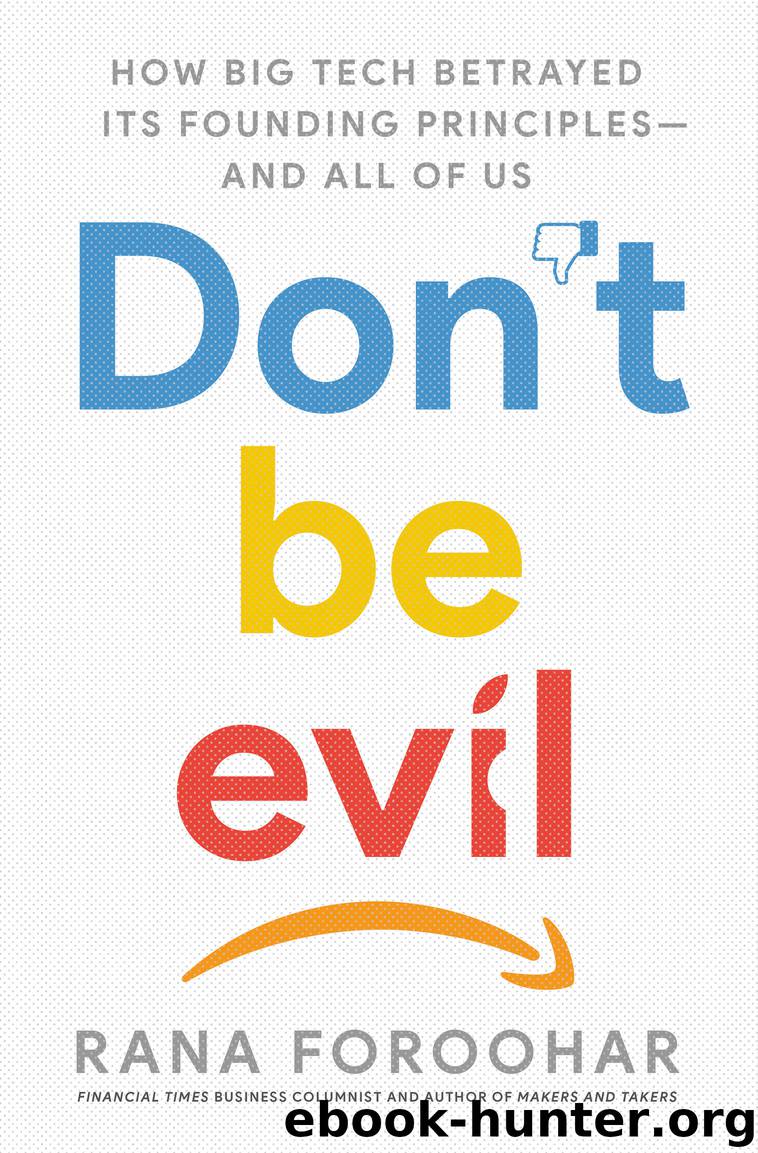
Author:Rana Foroohar
Language: eng
Format: epub
Publisher: The Crown Publishing Group
Published: 2019-11-04T16:00:00+00:00
The Plight of the Gig Worker
“Gig work” seems to have reached a new apex with the rise of companies like Uber. Consider the typical non-medallion taxi driver in New York, who might work for three or more companies at once: Uber, Lyft, and perhaps even an unlicensed cab firm. There is some truth to the claim that such people are essentially entrepreneurs, with all the freedom that working for themselves entails. With Uber, drivers set their own hours and are in a sense their own boss, something Kalanick always lauded as highly empowering. “There is a core independence and dignity you get when you control your own time,” he told me in 2015. Fair enough. But that’s about all Uber drivers are in control of. They have no say in the company’s pricing, which changes regularly depending on the level of demand and often means lowering rates to get more people into Uber cars. That varies based on the algorithm; according to my own anecdotal interviews with drivers in NYC, it has been decreasing as Uber has built its market share, and is around 20 percent now, as opposed to roughly 30 percent for the local independent cab services that some people in the neighborhood still use.
Uber touts its drivers as “free and independent” contractors, yet thanks to its automated algorithmic management system, the company is able to control how they work and penalize them when their behaviors deviate from what might be most profitable—for Uber.10 Using artificial intelligence, Uber is able to identify a class of consumers that might be willing to pay more than others for rides, depending on their zip codes. Uber can then pocket that extra take without giving more to drivers; the pay of the worker can be fundamentally decoupled from what passengers pay. Moreover, because Uber self-identifies as a technology company rather than a transportation company, it avoids complying with protections like the Americans with Disabilities Act, that would normally apply to this type of work. In her book Uberland, the social scientist Alex Rosenblat rode five thousand miles with numerous Uber drivers in twenty-five cities across the United States and Canada. She found that, not surprisingly, while Uber itself took most of the upside of the business, drivers were often left to bear the cost and the downsides of the disruptive technology on their own.
Lyft, Uber’s biggest competitor, has always been known as the kinder, gentler ridesharing company, in part because its CEO Logan Green has been more inclined to discuss the downsides of the sharing economy in a thoughtful and open way (that and the fact that he hasn’t been caught on a dashcam screaming at his own drivers). Green is, for example, concerned about the potential mass displacement of drivers in the United States (which represents the largest single category of work for men with a high school degree or less) by autonomous vehicles. Drivers themselves have reported being able to make more money on Lyft relative to Uber, and have higher levels of job satisfaction.
Download
This site does not store any files on its server. We only index and link to content provided by other sites. Please contact the content providers to delete copyright contents if any and email us, we'll remove relevant links or contents immediately.
The Brazilian Economy since the Great Financial Crisis of 20072008 by Philip Arestis Carolina Troncoso Baltar & Daniela Magalhães Prates(360865)
International Integration of the Brazilian Economy by Elias C. Grivoyannis(111585)
The Art of Coaching by Elena Aguilar(53640)
Flexible Working by Dale Gemma;(23354)
How to Stop Living Paycheck to Paycheck by Avery Breyer(19834)
Thinking, Fast and Slow by Kahneman Daniel(12526)
The Acquirer's Multiple: How the Billionaire Contrarians of Deep Value Beat the Market by Tobias Carlisle(12428)
The Radium Girls by Kate Moore(12177)
The Art of Thinking Clearly by Rolf Dobelli(10711)
Hit Refresh by Satya Nadella(9250)
The Compound Effect by Darren Hardy(9146)
Tools of Titans by Timothy Ferriss(8590)
Atomic Habits: Tiny Changes, Remarkable Results by James Clear(8514)
Turbulence by E. J. Noyes(8200)
A Court of Wings and Ruin by Sarah J. Maas(8106)
Change Your Questions, Change Your Life by Marilee Adams(7928)
Nudge - Improving Decisions about Health, Wealth, and Happiness by Thaler Sunstein(7850)
How to Be a Bawse: A Guide to Conquering Life by Lilly Singh(7612)
Win Bigly by Scott Adams(7342)
